 British Manufacturer | Est. 1890
  ISO Registered Company





Flexible Metal Conduit: Galvanised vs Stainless Steel
Flexible metal conduit provides mechanical protection for electrical wiring while allowing cables to be routed around machinery, equipment and installations where rigid conduit may be impractical.
Two common choices are galvanised steel flexible conduit and stainless steel flexible conduit.
Both provide the strength and flexibility associated with metallic conduit, but differences in material, corrosion resistance, temperature capability and operating environment can make one more appropriate than the other.
So, how do you decide which flexible metal conduit to use?
What Is Flexible Metal Conduit?
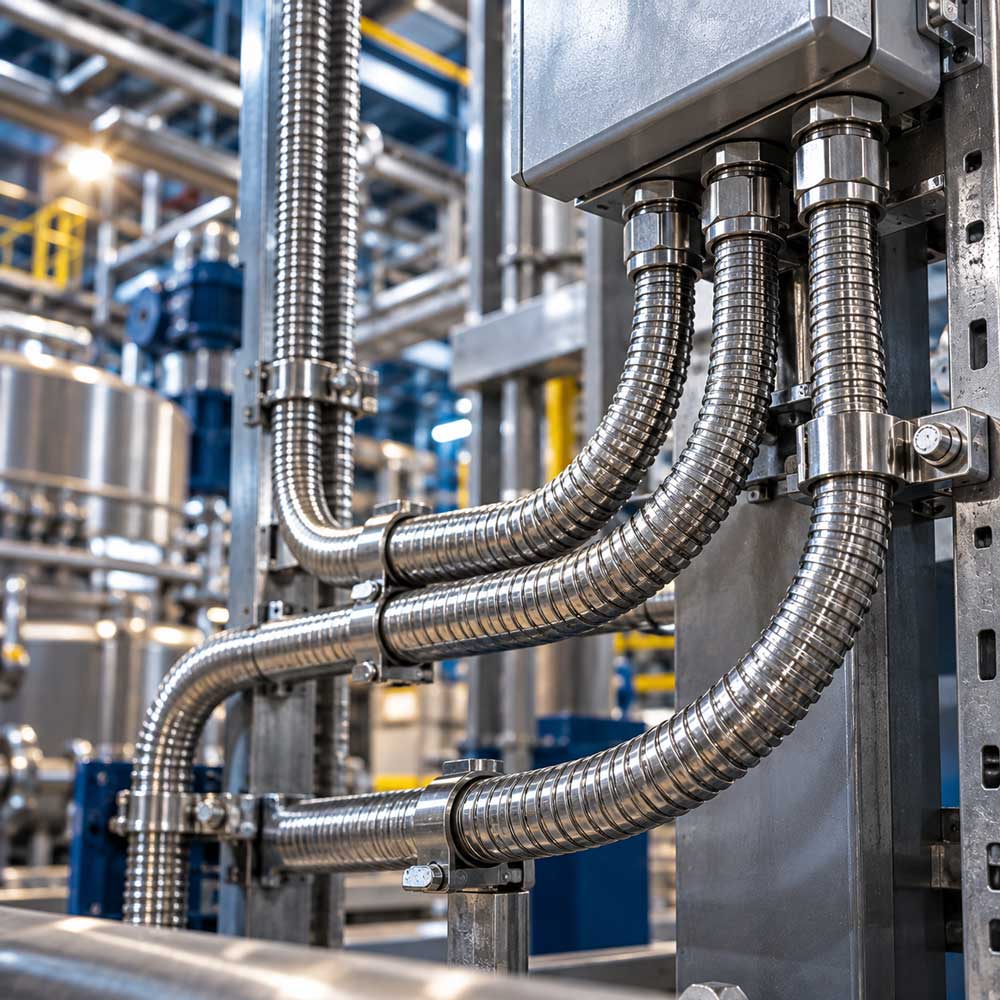
Flexible metal conduit is a metallic tube designed primarily to protect and route electrical wiring while retaining sufficient flexibility to follow bends, accommodate difficult installation routes and connect equipment.
It is commonly used within:
- Industrial machinery
- Manufacturing equipment
- Electrical installations
- Building services
- Control equipment
- OEM machinery
- Areas subject to movement or vibration
- Installations where additional cable protection is required
Flexible conduit can be particularly useful where rigid conduit would make installation or maintenance difficult.
Why Use Flexible Conduit Instead of Rigid Conduit?
Rigid conduit provides excellent cable protection but is not ideal for every installation.
Flexible conduit can make it easier to:
- Route cables around machinery
- Negotiate bends
- Connect moving or vibrating equipment
- Work within restricted spaces
- Accommodate minor misalignment
- Replace or maintain equipment
- Connect machinery to fixed electrical installations
The choice between rigid and flexible conduit should be based on the mechanical and environmental requirements of the installation.
What Is Galvanised Flexible Conduit?
Galvanised flexible conduit uses steel construction with a protective zinc coating.
It provides a combination of mechanical strength, flexibility and cost effectiveness, making it suitable for a wide variety of general industrial and electrical applications.
Whitehouse supplies several forms of galvanised flexible steel conduit, including uncovered and PVC-covered constructions.
For general cable protection in industrial and building-services applications, galvanised steel can provide a practical and economical solution.
What Is Stainless Steel Flexible Conduit?
Stainless steel flexible conduit provides many of the same mechanical benefits while offering greater resistance to corrosion and a wider potential operating environment.
Whitehouse S-DNP Stainless Steel Uncovered Conduit is manufactured from Type 304 stainless steel as standard, with Type 316 stainless steel available by request.
The stainless steel construction can make it particularly useful for applications involving:
- Outdoor environments
- Marine applications
- Food-related environments
- Chemical environments
- Greater temperature requirements
- Conditions where corrosion resistance is important
Material selection should always be based on the complete operating environment rather than simply specifying stainless steel by default.
Galvanised vs Stainless Steel Flexible Conduit
The best choice depends on the application.
Galvanised Steel Flexible Conduit
Typical advantages include:
- Strong metallic cable protection
- Good flexibility
- Cost-effective construction
- Suitable for many general industrial applications
- Available in uncovered and coated versions
- Wide range of sizes and fittings
Stainless Steel Flexible Conduit
Typical advantages include:
- Increased corrosion resistance
- Suitable for more demanding environments
- Good mechanical protection
- Suitable for higher-temperature applications where the selected construction permits
- Type 304 stainless steel available as standard on applicable Whitehouse products
- Type 316 available for certain applications by request
Where corrosion resistance is not a significant consideration, galvanised conduit may provide the most economical solution. Where environmental exposure is more demanding, stainless steel may provide a more appropriate choice.
What About PVC-Covered Flexible Metal Conduit?
An additional option is PVC-covered galvanised steel conduit.
This combines a flexible metallic core with an external PVC covering, providing additional protection against moisture, dust and splashing.
Whitehouse DFC Galvanised Steel PVC Covered Conduit, for example, has an IP65 rating for the conduit itself and an operating temperature range of -25°C to +75°C.
A covered conduit can therefore be useful where the mechanical protection of steel conduit is required alongside greater environmental protection.
Which Flexible Conduit Should I Use for Outdoor Applications?
The answer depends on the level and type of exposure.
Factors include:
- Rain and moisture
- Corrosive atmosphere
- Temperature
- UV exposure of any external covering
- Mechanical impact
- Required IP rating
- Fittings being used
Stainless steel may be appropriate where corrosion resistance is particularly important.
Alternatively, a suitably specified covered galvanised conduit may provide the required ingress protection for some installations.
The conduit and fittings should be considered together when assessing the environmental protection of the complete system.
Choosing Flexible Conduit for Industrial Machinery
Industrial machinery is one of the areas where flexible conduit can provide significant installation advantages.
Cables may need to pass around frames, motors, guards and moving equipment while remaining mechanically protected.
Consider:
- Required conduit diameter
- Number and size of cables
- Bend radius
- Movement and vibration
- Temperature
- Exposure to oils, moisture or chemicals
- Mechanical impact
- Required ingress protection
- Type of fittings
- Installation environment
Choosing the conduit solely on diameter can overlook several factors that affect long-term performance.
What Size Flexible Conduit Do I Need?
The correct size depends primarily on the cables being protected and the requirements of the installation.
Allow sufficient internal space for the cables without forcing them tightly into the conduit.
You should also consider:
- Number of cables
- Cable outside diameters
- Required bend radius
- Length of the conduit run
- Ease of cable installation
- Applicable electrical requirements
- Fittings required at each end
Whitehouse flexible conduit products are available in a range of trade sizes, with compatible fittings available for suitable conduit systems.
What Is Pre-Wired Flexible Conduit?
For applications involving repeat installations or manufacturing processes, conduit can also be supplied as part of a pre-wired assembly.
Rather than cutting the conduit, preparing the cable and assembling the components separately during installation, the conduit assembly can be prepared to the required specification in advance.
This can be particularly useful for:
- OEM manufacturing
- Production machinery
- Repeat installations
- Control systems
- Equipment manufacturers
- Applications requiring consistent conduit lengths
Whitehouse offers pre-wired conduit assemblies alongside standard and non-standard conduit lengths.
Don’t Forget the Conduit Fittings
The conduit itself is only one part of the installation.
The correct fittings are required to connect the flexible conduit securely to machinery, enclosures or other components.
Whitehouse supplies conduit fittings including fixed male fittings and swivel fittings designed to suit DIN-standard conduits.
The fitting should be selected according to the conduit size, thread requirement and environmental requirements of the complete installation.
Frequently Asked Questions About Flexible Metal Conduit
What is flexible metal conduit used for?
Flexible metal conduit is primarily used to route and mechanically protect electrical wiring where flexibility is required. Common applications include industrial machinery, manufacturing equipment, building services, OEM equipment and installations involving vibration or difficult cable routes.
Is stainless steel conduit better than galvanised conduit?
Neither is automatically better. Galvanised steel provides strong, cost-effective cable protection for many general applications. Stainless steel offers increased corrosion resistance and can be preferable in more demanding environments. The correct choice depends on the installation.
What is the difference between covered and uncovered flexible conduit?
Uncovered conduit has an exposed metallic exterior. Covered conduit incorporates an additional outer covering, such as PVC, which can provide increased protection against environmental conditions such as moisture, dust and splashing.
Can flexible metal conduit be used outdoors?
Suitable conduit constructions can be used outdoors, but the material, covering, fittings, IP requirements and environmental exposure must all be considered. Stainless steel or an appropriately covered conduit may be required depending on the conditions.
Is flexible metal conduit suitable for industrial machinery?
Yes. Flexible conduit is widely used to protect electrical wiring on industrial machinery because it combines mechanical protection with the ability to accommodate bends, routing constraints and movement.
Can stainless steel flexible conduit withstand high temperatures?
Temperature capability depends on the specific construction. Whitehouse S-DNP uncovered stainless steel conduit, for example, has a stated operating range from -100°C to +400°C. Always check the specification of the individual conduit before use.
Can flexible conduit be supplied pre-wired?
Yes. Whitehouse can supply pre-wired conduit assemblies, which can be useful for OEM equipment, repeat production and installations where conduit and wiring need to be prepared to a consistent specification.
What information should I provide when ordering flexible conduit?
Useful information includes the required conduit size and length, number and size of cables, operating temperature, installation environment, required ingress protection, movement or vibration and the fittings required at each end.
Choosing the Right Flexible Metal Conduit
The choice between galvanised and stainless steel flexible conduit ultimately depends on the environment in which it will operate.
For many general industrial applications, galvanised flexible conduit provides an effective combination of strength, flexibility and value. For environments where corrosion resistance or increased temperature capability is important, stainless steel flexible conduit may be more appropriate.
Whitehouse Flexible Tubing manufactures and supplies flexible metallic conduit, fittings, non-standard lengths and pre-wired conduit assemblies for a wide range of industrial applications.
Explore our flexible metal conduit range or contact Whitehouse with your application requirements for help identifying the most suitable conduit and fittings.


