 British Manufacturer | Est. 1890
  ISO Registered Company
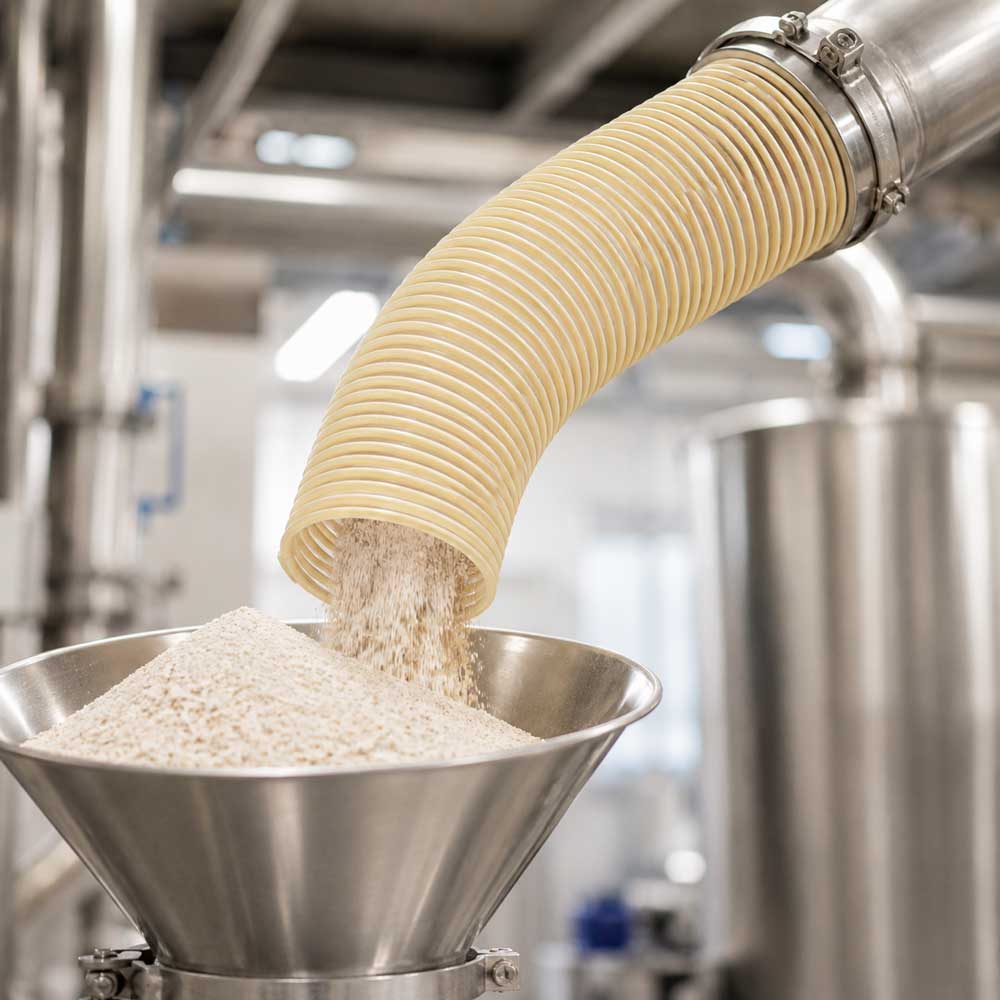
Food manufacturing and processing environments often require flexible hose to transfer ingredients between machinery, storage and processing equipment. Flour, sugar, grain, cereals and other dry ingredients can present very different challenges from air or water, making it important to select a hose designed for the application.
A suitable food grade hose needs to provide the required food contact compliance while also offering the flexibility, abrasion resistance and flow characteristics needed for regular material transfer.
What Is a Food Grade Hose?
A food grade hose is designed for applications where the hose may come into contact with food products or ingredients.
The construction and materials used need to be appropriate for the intended food contact application. Requirements can vary according to the food being transferred, operating temperature and conditions of use, so the relevant food contact documentation should always be checked before specifying a hose.
Food grade hoses are available for both liquid and dry food applications, including the transfer of powders, flour, sugar and grain.
Choosing a Hose for Flour and Powder Transfer
Flour and other powdered ingredients require careful consideration when selecting flexible hose.
Regular movement of dry materials can cause abrasion to the inside of a hose. A hose used for flour or powder transfer therefore needs to provide suitable abrasion resistance while remaining flexible enough for the equipment and installation.
A smooth internal surface can also help promote efficient material flow and reduce areas where material can collect.
Polyurethane is consequently used in many flexible hoses intended for dry food transfer because it can provide a useful combination of flexibility and abrasion resistance.
Food Grade Hose for Grain and Cereals
Grain, cereals and similar materials can also place significant demands on a hose.
The movement of solid particles through the hose makes abrasion resistance an important consideration, particularly in applications involving frequent or continuous transfer.
When choosing a food grade suction hose for grain, factors to consider include:
- The type of food being transferred
- Internal hose diameter
- Required flexibility
- Abrasion resistance
- Suction or vacuum requirements
- Operating temperature
- Food contact requirements
- Frequency of use
Choosing a hose based purely on its diameter may therefore result in a product that isn’t ideally suited to the complete application.
Why Use Polyurethane Food Grade Hose?
Polyurethane, often abbreviated to PU, is widely used for flexible industrial hose because it can combine flexibility with good resistance to abrasion.
For food handling applications, a polyurethane food grade hose manufactured from suitable materials can be used for transferring a variety of dry food ingredients while retaining the flexibility required for connection to processing and handling equipment.
Whitehouse Flexible Tubing’s Eolo PU Food is manufactured using an ether-based polyurethane wall with a rigid PVC spiral. Its smooth internal surface helps material flow, while the corrugated exterior provides flexibility.
Can the Same Food Grade Hose Transfer Liquids?
Some food grade hoses are suitable for both dry ingredients and liquids, although this should never be assumed.
The intended food product and the manufacturer’s food contact information need to be checked before use.
Eolo PU Food is designed for the suction and transfer of both dry food products and suitable liquids. Typical applications include flour, sugar, grains and animal feed as well as appropriate food liquids.
It is suitable for applicable aqueous and fatty food applications within the conditions stated in its food contact documentation, but it is not recommended for milk or dairy products.
Food Contact Compliance
Food contact compliance should be one of the key considerations when specifying hose for food processing.
Eolo PU Food complies with FDA Regulation CFR 21 Item 177.2600 and EU Regulation 10/2011 for the applicable food classes and stated conditions of use.
Always consult the relevant Food Contact Declaration when assessing a hose for a particular food product or processing environment.
Temperature and Working Conditions
Temperature can affect both the performance of the hose and its suitability for a particular food contact application.
Eolo PU Food has an operating temperature range from -40°C to +80°C, providing a broad working range for food handling and processing applications.
Other factors such as pressure, vacuum, bend radius and the material being transferred should also be considered when choosing a hose.
Choosing the Correct Food Grade Hose
There isn’t a single flexible hose suitable for every food processing application.
For dry ingredients such as flour, sugar and grain, abrasion resistance and material flow may be particularly important. Liquid applications can introduce different requirements, while some installations may require additional properties such as antistatic performance.
Whitehouse Flexible Tubing supplies a range of food grade hoses for different food processing and transfer applications.
For the suction and transfer of flour, sugar, grain, animal feed, dry food products and suitable liquids, explore our Eolo PU Food polyurethane food grade hose or contact our team for assistance selecting the correct hose for your application.


